Marine Mammal Stranding Network

Marine mammal strandings are common along the Florida coast and occur when live animals beach themselves or dead animals wash up on shore. Many of the reasons why live animals beach themselves are unknown. When a stranding occurs in Volusia County, a team of volunteers, the Volusia County Marine Mammal Stranding Team (VCMMST), are notified to assess the situation.
When responding to cetacean (dolphin or whale) strandings, the Stranding Team operates under the Hubbs-Sea World Research Institute (HSWRI) Marine Mammal Stranding Agreement. Agreement is authorized by the National Marine Fisheries Service Marine Mammal Health and Stranding Response Program for the Southeast Region. Manatees, on the other hand, are under the supervision of the state’s Florida Fish and Wildlife Conservation Commission (FWC). When responding to manatee strandings, the Stranding Team operates under the direction of the FWC with a Letter of Authorization from the U.S. Fish and Wildlife Service.
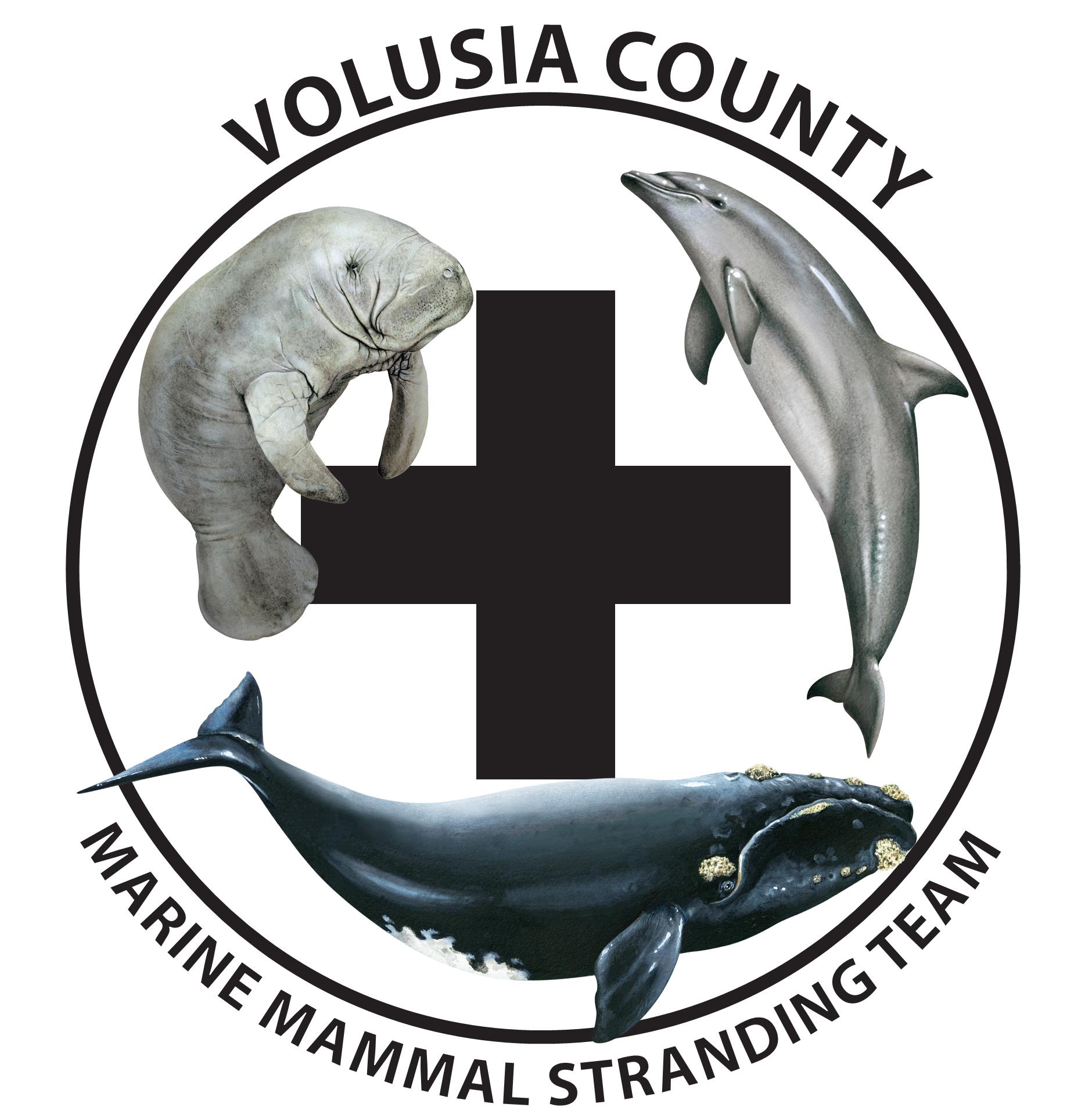 Florida manatees (Trichechus manatus latirostris) and bottlenose dolphins (Tursiops truncatus) are the most common animals that are found stranded in Volusia County. Occasionally, pygmy sperm whales (Kogia breviceps), North Atlantic right whales (Eubalaena glacialis), humpback whales (Megaptera novaeangliae), fin whales (Balaenoptera physalus), some species of beaked whales, and Atlantic spotted dolphins (Stenella frontalis) may also be found.
When a cetacean is reported as stranded, HSWRI is notified and they then notify the VCMMST coordinator. A Stranding Team member then travels to the stranding location and assesses the situation. The team member takes measurements, determines sex, and sometimes a field necropsy is conducted on dead animals in order to obtain samples for further analysis by HSWRI. If a manatee is found stranded, the VCMMST receives notification from FWC. A team member will locate the animal and verify its condition and location. FWC personnel then arrive to transport the animal to the appropriate facility. Live manatees in need of medical care are transported to a rehabilitation facility while dead manatees are taken to the Marine Mammal Pathobiogy Lab.
A stranded animal can provide an opportunity for data to be collected that cannot be obtained in any other way. The data collected from a stranded animal can help researchers determine if there are environmental causes that may be creating problems for marine life or humans, or whether the stranding was a natural occurrence. This information may help to determine the cause of death, along with expanding our knowledge of cetacean physiology, including feeding and reproductive habits. In all live stranding cases, the animal needs medical care and will be transported to a rehabilitation center for treatment. If the animal is mortally injured or in the last
stages of dying, humane euthanasia may be required.
If you see a stranded marine mammal do not attempt to push it back in the water. These animals need immediate attention; they will beach themselves again if placed back in the water, and use up much needed energy in the process.
For stranded manatees, whales, and dolphins call:
Florida Fish and Wildlife Conservation Commission (FWC): 1-888-404-3922
For right whale sightings call the Right Whale Hotline: 1-888-979-4253
What you can do to help:
- Call the FWC hotline number.
- Do not push the animal back into the water.
- These animals are sick and sometimes orphaned and will beach themselves again.
- Keep people and pets away from the animals.
- Do not touch the animal because it may cause it more stress.
- Avoid the tail area because the animal may thrash around.
Dolphin & Whale 911 - Free application for smart phones
The Dolphin & Whale 911 app enables the public in the Southeast U.S. to immediately report live or dead stranded, injured, or entangled marine mammals by connecting them to the nearest stranding response hotline which is detected through the phone’s internal GPS system (the GPS pinpoints the user's location and, in turn, calls the appropriate local hotline number. Please note that the user will receive an error message if they are outside of the Southeast U.S.). The app will help the user identify the stranded animal by providing an electronic field guide of marine mammals found in the Southeastern U.S. and provides a list of "do’s and don’ts" or tips on what to do when you find a live or dead stranded marine mammal. The app also allows users to take and send a photo of the marine mammal that is time/date/GPS coordinate stamped to a generic NMFS e-mail address. The app is currently available for download on iTunes and in the Google Play store.
SEE & ID Dolphins & Whales - Free application for smart phones
The SEE & ID Dolphins & Whales app is an electronic field guide that assists the public in identifying marine mammals in the Southeast U.S. and provide species information, such as physical description, biology, habitat, conservation/status and photos. The app also informs that public of appropriate ways to enjoy viewing marine mammals in the wild without harming or harassing them. The app is currently available for download on iTunes and in the Google Play store.
https://itunes.apple.com/us/app/see-id-dolphins-whales/id699127250?mt=8
For more information on marine mammals check out the following links:
Northern Right Whales PDF
You must have the Acrobat Reader to view and print pdf files. If you do not have the Acrobat Reader, you may download it from here.
National Marine Fishery Service
http://www.nmfs.noaa.gov Hubbs-Seaworld
http://www.hswri.org Marine Mammal Center
Marine Mammal Protection Act - Marine Mammal Commission Marine Mammal Protection Act