Dune planting
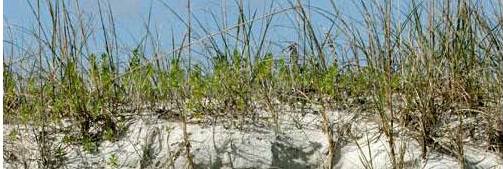
Dunes provide the first line of defense against coastal storms. Native dune plants have adapted well to the harsh environment in which they live, they have to be able to withstand salt spray, heat, burial by sand and very dry conditions. The root systems of dune plants play a vital role in dune stabilization. When wind blows sand along the beach the roots and stems of the dune plants trap the sand creating dunes or adding sand to the dune system. Many dune plants, including sea oats, have root systems with vertical roots that enable the plant to take advantage of water present at lower levels and roots that spread out underneath the surface of the dune, in order to take advantage of any rainfall. Some roots that spread out under the surface may form rhizomes; these are roots from which stems emerge to form new plants.
Volusia County is home to a wide range of native beach plants. Sea oats (Uniola paniculata) are the most commonly known. Others, such as saltgrass (Distichlis spicata), beach sunflower (helianthus debilis), railroad vine (Ipomoea pes-caprae), beach panicgrass (Panicum amarum), seashore paspalum (paspalum distichum), sea purslane (Sesuvium portulacastrum), saltmeadow cordgrass (Spartina patens) and seashore dropseed (Sporobolus virginicus) are also common throughout Volusia beaches.
Beach and dune plantings are encouraged by Environmental Management. They are exempt from needing a county permit if done as an independent native plant project but must always be completed between Nov. 1 and April 30 to avoid sea turtle nesting season.
State law requires you to have a permit to plant vegetation on sand dunes. Permits are issued by Florida Department of Environmental Protection. A field permit can be obtained by contacting Melanie Cain at 386-895-1958 or by email, Melanie.Cain@FloridaDEP.gov.