New Smyrna Beach's archaeological resources
In 1996, archaeologists excavated the remains of a colonial house that was threatened by construction. The building was rectangular, measuring about 13 x 28.5 feet. It had a central chimney with two fireplaces and hearths, one for each of two rooms separated by internal walls. The chimney, fireplaces, and hearths were built of coquina, a naturally occurring rock that was obtained from nearby quarries. The floor was mortar mixed with sand and shell. Charred posts at regular intervals around the wall indicate that the building had a post-and-beam framework. Wood impressions in fragments of wall mortar, and charred wood lathing with embedded nails, indicate that the walls were made by nailing horizontal split-wood lathing to the vertical posts and covering these with mortar. No roofing material was recovered but the house probably had a palmetto-thatch roof.
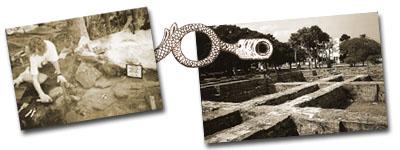
Perhaps the most well-known, and certainly the most visible, material remains associated with the New Smyrna colony are the coquina foundations at Old Fort Park in downtown New Smyrna Beach. The function of the foundations remains a mystery. An early account, written in 1776 - about a year prior to the colony's demise - states that construction of a "very large stone building" had begun at New Smyrna for "a mansion house." During the 1930s, the ruins were "restored" by Works Progress Administration workers. Believing that the thick coquina walls represented a fort, the restorers added bastions, but there is no historical or archaeological evidence for such a reconstruction. Some archaeologists and historians have recently suggested that the foundations originally supported a church or perhaps a large storehouse. Archaeological excavations suggest that the latter interpretation is most likely. The depth of the footers, the massiveness of the coquina walls, and the thickness of tabby floors found next to the structure imply a commercial or industrial use. In addition, the wear patterns on the floors indicate a great deal of foot traffic, such as might be expected in a commercial building.
A network of canals, believed to have been dug by Turnbull's colonists, is visible today running through areas of New Smyrna Beach and unincorporated Volusia County. The South Canal is the present dividing line between New Smyrna Beach and Edgewater. The North Canal once ran through the center of the downtown area, and portions can still be seen west of town. A third canal is located just south of the city's municipal airport. These three canals were linked by a fourth, longer canal that ran north-south, beginning at Turnbull Bay. These hand-dug canals, a massive undertaking by an already overworked people, may have served several purposes for the colony, such as irrigation, drainage of swampy lands, and transportation within the colony.