
Natural treasures: By Lani Kathleen Friend
Many of the early explorers came to this area seeking gold and silver. They would leave never knowing that the real treasure lay all around them.
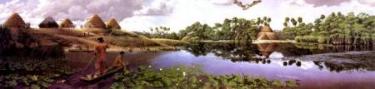
Museum of Florida History, Division of Historical Resources, Florida Department of State
The first inhabitants of east-central Florida, the ancestors of Florida's native Americans, were drawn to the area by its natural resources: a spacious waterway to the interior on the west, the marine bounty of the Atlantic on the east, and in between a range of habitats that nurtured an abundance of wildlife.
Since the era when native people migrated far and wide to hunt game, the spiny ridge of the central highland together with cypress swamps and coastal marshes have been home to a variety of animals. These diverse habitats are part of a statewide ecology that boasts more wildlife species than any state east of the Mississippi River.
|
Abundant resources combined with a temperate climate to make it possible for both people and animals to live off the land year round. For these and other reasons, many cultures crossed paths along the river, the coast, and the central interior.French Protestants came in search of religious freedom; Spanish explorers sought a military stronghold on the route of treasure fleets from the Indies; Colonial planters later came from Britain and the Bahamas to establish vast plantations worked by African slaves; and settlers of all nationalities maneuvered oxcarts and schooners through impenetrable wilderness to meet the challenges of this new frontier. |
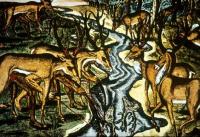 Theodore de Bry, Brevis Narratio, Theodore de Bry, Brevis Narratio,Frankfort 1591 |
Many discovered a "tropical paradise;" others found only a "green inferno." But whatever their perspective, each wave of new arrivals left its influence.
From its beginnings, Volusia County has been shaped by a collage of cultures: as a crossroads of trade on the river the Creeks called "Illaka" (river that wanders); as a colonial outpost under Spanish, British, and American flags; and as an enduring natural resort that continues to attract visitors and residents from all over the world. (Photo Copyright Theodore de Bry, Brevis Narratio, Frankfort 1591)
An Old New World
In 1566, the Florida river that now forms Volusia County's western border saw two cultures collide. That was when Spanish Admiral Pedro Menendez de Aviles rowed up the St. Johns and encountered first Timicuans and Mayaca Indians. The year before, Menendez had crushed a French settlement at the river's mouth (near present-day Jacksonville), and now he returned to explore inland and southward. A chance turn of the weather helped shape the outcome of that fateful encounter.
The Wizard of Weather
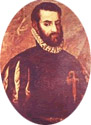
Pedro Menendez set off upriver with an Indian guide and one hundred men, landing north of Lake George. They walked inland to the village of Chief Otina. A six-month drought had parched the cornfields of the Timucua Indians. Menedez used his uncanny ability to predict the weather as part of his military strategy.
Otina had heard that Menendez performed rain miracles for other tribes and sent messengers to him requesting a similar miracle. Menendez timed his arrival at the village to coincide with the first storm of the season. As he marched in, dark clouds loosed a torrent of rain. Awed by his display of supernatural power, the chief fled into the woods and refused to come out.
Menendez gave up on meeting the chief and sent word to warn the villages upriver of his coming. He continued on with one ship and 50 men to the village of Mayaca, south of Lake George near present day Volusia. Once again, the Spanish found an empty village. The chief with all his people had fled in fear. An interpreter sent to find them was told that Menendez would not be harmed if only he would turn back.
|
As the Spanish brigantine pushed against the current, bands of Indians armed with bows and arrows threatened them from the banks. Where the stream narrowed, a row of stakes blocked their way. Menendez fearlessly broke through the barrier. Several Indians sent by the chief immediately confronted the boat and made it clear that going on would mean war. |
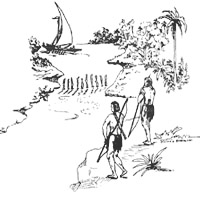 Sketch by Victoria Bortolussi Sketch by Victoria Bortolussi |
The guide warned the Spanish party that the country ahead was filled with Indians. Knowing his ammunition was useless from the rain, Menendez backed down. The Spanish remained overnight, then retreated.
Menendez and his men were relative newcomers to east Florida (where European exploration had begun in the early 1500s), and the native residents they saw were only the latest in a string reaching far back in time. More than 5,000 years before the Spanish arrived, people already had year-round villages along the St. Johns River. Many thousands of years before that - during times of lower sea levels, a wider Florida peninsula and a drier area - the region's earliest residents may have lived in what is now Volusia County. While traces of these first Paleo-Indians are scarce here, the people who followed them left considerable evidence. Some of it has been found, but much remains to be learned about Florida's early inhabitants.