Who was here before the Europeans?
Who was here?
When Europeans arrived in the 1500s, East Florida was home to people of the St. Johns Culture - a modern archaeological tag. Explorers had their own names for the inhabitants they found, but what these people called themselves is not always clear. The Spanish termed some of this region's natives Timucua, a word Europeans apparently got from local informants and changed.
Timucua
|
The Timucua included more than 30 tribes, many speaking different dialects of the same language. Though they were numerous in the northern third of Florida and in Southern Georgia, intertribal warfare kept them from becoming politically unified. North of Lake George lived the Freshwater Timucua, while along the coast, from the mouth of the St. Johns down to Turtle Mound, were people sometimes labeled the Eastern Timucua. |
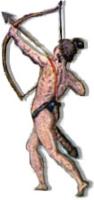 Theodore de Bry (edited) Theodore de Bry (edited) |
Mayaca
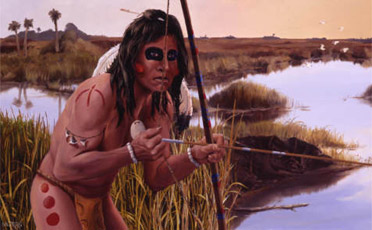
"Everglades Hunter" painting courtesy of Theodore Morris
Europeans also reported other natives in or near present-day Volusia County. South of Lake George on the St. Johns lived people the Spanish called the Mayaca. Accounts place them along the river up to modern-day Seminole County, at which point the Jororo people became dominant.
On the coast, the Spanish noted natives occupying a region from Turtle Mound south to Cape Canaveral. Named Surruque, they are thought to have been related to the Ais people, whose larger southeast coast culture may also have had Turtle Mound as its northern boundary.
Before the Europeans
The earliest occupied sites in Florida date from 12,000 years ago, when nomadic hunters called Paleo-Indians roamed over vast areas. During that time, the climate was much drier and cooler than today, and water was in short supply.

Paleo-Indians were drawn to the northern and panhandle "limestone region" of Florida, where surface water collected in watering holes used by animals and human beings alike.
Around 8000 B.C., the climate began to warm, glaciers melted, and sea levels rose. Water was more plentiful, allowing people to live in more permanent camps. Mammoths and other large game animals became extinct, and smaller game such as deer and raccoons proliferated. This marked the beginning of the Archaic Period.
The trend toward a wetter climate continued from 5000 to 3000 B.C. as Florida's human population grew and spread out. By the late Archaic period, people were living along the coast of east-central Florida in large numbers and settling the St. Johns River valley. The area's coastal estuaries and freshwater marshes provided a rich source of food; and as villages of this era became permanent, they developed distinctive ways of life. After 500 B.C., regional cultures like the St. Johns Culture began to stand out.
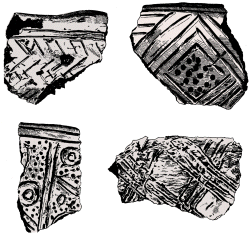
Pottery fragments from the St. Johns River and Lake Monroe described by Jeffries Wyman, 1867
Around 2000 B.C., Florida saw a landmark development in its native cultures: the making of fired pottery, with the clay bound by plant fibers such as palm fronds and Spanish moss. Before then, containers were made of wood, basketry, gourds, or other natural materials. It is not known where this pottery making began, but it spread from coastal South Carolina and Georgia down to southwestern Florida.
Each region produced its own style of pottery, and these differences in ceramic artifacts have helped scientists sort the people who created them. Whatever its special features, the St. Johns Culture was heading for a fatal challenge around 1500 A.D.